


From Scales to Symphonies—Mind Map Your Way to Music Mastery!
Unlocking the Secrets of Music with Mind Mapping

Learning music can feel like trying to read an ancient, cryptic language. Whether you’re mastering an instrument, studying music theory, or composing your own pieces, there’s a lot to take in—notes, rhythms, scales, chords, key signatures, dynamics, styles… it’s enough to make your brain sing (or scream).
But what if you could see the structure of music clearly and make it stick in your memory?
This is where hand-drawn Mind Mapping becomes a game-changer. Instead of drowning in dry textbooks and endless practice drills, you can visualise your musical journey in a way that makes it fun, engaging, and incredibly effective.
Ready to turn your musical chaos into harmony? Here are four expert secrets to Mind Mapping your way to music mastery!
🎵 Secret #1: Learn Music Theory Faster with Mind Maps
Music theory can seem like a tangled mess of rules, symbols, and abstract concepts. But what if you could break it down into something you can actually understand?
Solution: Create a Music Theory Mind Map
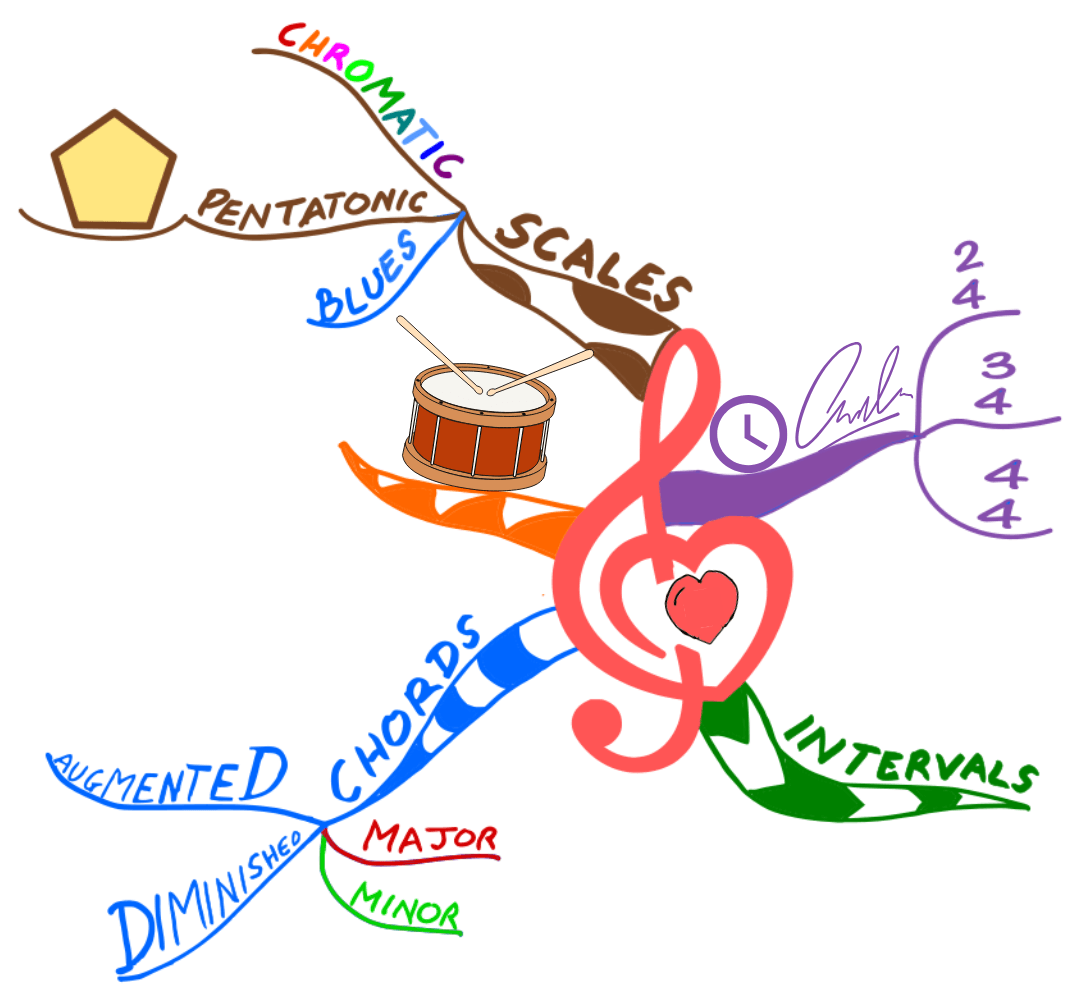
Instead of memorising dull definitions, turn them into a visual masterpiece that makes connections easy to see.
🎯 How to do it:
✅ Central Image: A treble clef 🎼 or a musical note 🎶.
✅ Branches = Core Topics: Scales, chords, intervals, time signatures, rhythm.
✅ Sub-branches = Details: Under “Chords,” add major, minor, diminished, augmented. Under “Scales,” include pentatonic, blues, chromatic.
✅ Use colour-coding: Different colours for major vs. minor chords, or warm vs. cool keys.
🔥 Why This Works:
✔ Patterns become clearer, helping you recall music theory faster.
✔ Instead of memorising rules, you’re seeing how everything connects.
🎻 Secret #2: Master an Instrument with Mind Mapping
Whether you’re playing piano, guitar, violin, or drums, learning an instrument takes discipline. But it’s easy to feel overwhelmed by the sheer amount of techniques, fingerings, and drills you need to practise.
Solution: Create an Instrument Practice Mind Map
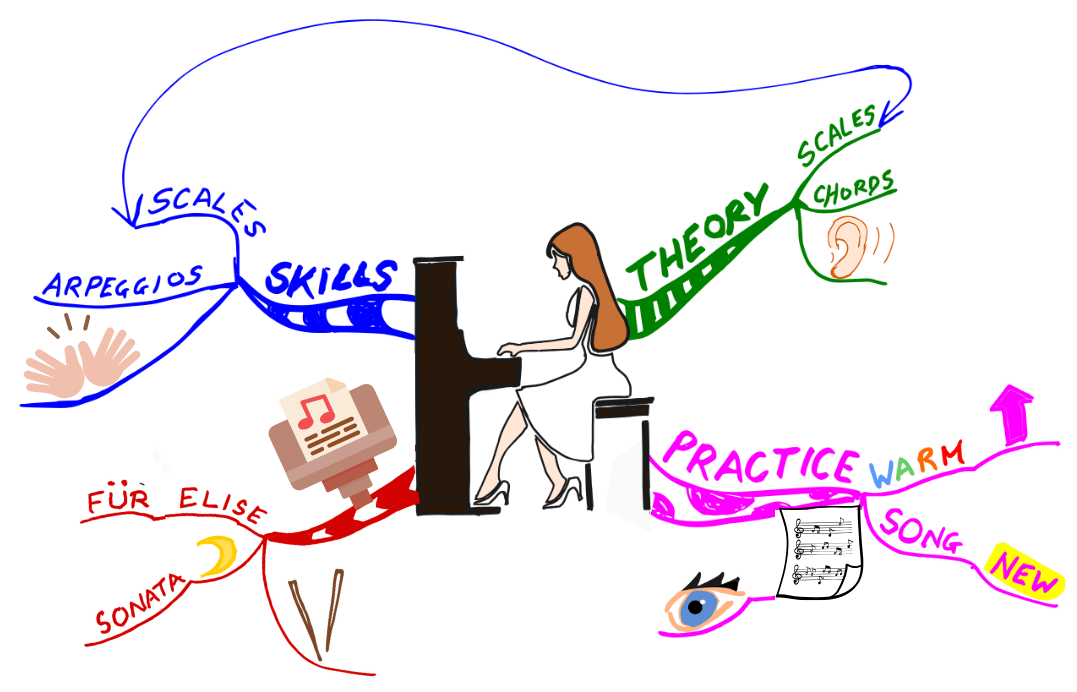
A Mind Map can help structure your practice sessions so you actually improve without feeling lost or stuck.
🎯 How to do it:
✅ Central Image: Your instrument 🎸🎹🥁.
✅ Branches = Core Skills: Finger exercises, technique, scales, repertoire, sight-reading.
✅ Sub-branches = Daily Practice Plan: Under “Technique,” include vibrato, trills, bowing for strings; under “Repertoire,” list your pieces & progress.
✅ Use imagery: Draw a small fretboard for guitar fingerings or a keyboard for piano notes.
🔥 Why This Works:
✔ Your practice becomes focused and intentional, so you progress faster.
✔ You can track improvement over time, keeping motivation high.
🎼 Secret #3: Compose and Arrange Music with Mind Maps
Ever had a melody pop into your head, but then you forgot it before you could write it down? Or maybe you’re stuck in a creative rut, struggling to compose something new?
Solution: Use a Mind Map for Songwriting & Composition
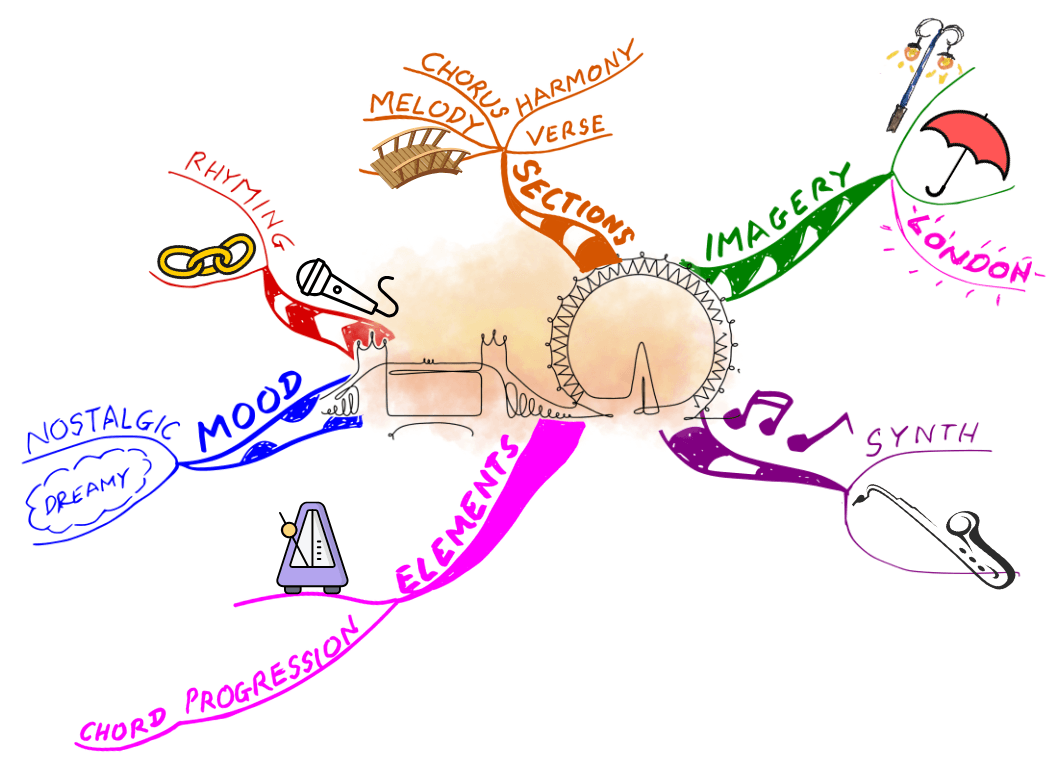
Mind Mapping helps you capture ideas before they vanish and structure your compositions in a way that makes writing music feel like play.
🎯 How to do it:
✅ Central Image: The theme of your composition 🎵.
✅ Branches = Sections of the Song: Verse, chorus, bridge, melody, harmony.
✅ Sub-branches = Musical Elements: Lyrics, chord progressions, instrumentation, tempo, dynamics.
✅ Sketch musical ideas: Jot down rhythms, lyric ideas, or key changes as you brainstorm.
🔥 Why This Works:
✔ You create a clear roadmap for your composition, making it easier to finish songs.
✔ Instead of random ideas floating around, everything is organised and accessible.
🎤 Secret #4: Improve Your Performance & Stage Confidence

Performing music—whether it’s for an exam, a gig, or just for fun—can be nerve-wracking. Even experienced musicians struggle with stage fright, shaky hands, or mind blanks.
Solution: Mind Map Your Performance Plan
A Mind Map helps you mentally prepare for a performance, so you step on stage with confidence and clarity.
🎯 How to do it:
✅ Central Image: The concert/gig setting 🎭.
✅ Branches = Preparation Areas: Warm-ups, memorisation, visualisation, stage presence.
✅ Sub-branches = Strategies: Under “Warm-ups,” include scales, breathing exercises, relaxation techniques.
✅ Visualise success: Write positive affirmations in bold (e.g., “I’ve got this!” 🎤).
🔥 Why This Works:
✔ You feel more prepared and in control, reducing performance anxiety.
✔ Having a mental rehearsal makes the real performance feel easier and more natural.
🎶 Final Thoughts: Map Your Way to Musical Mastery

Music is not just about theory or technique—it’s about expressing yourself freely and creatively. And Mind Mapping is the perfect tool to make learning music feel natural, structured, and fun.
Whether you’re:
✅ Mastering music theory 🎼
✅ Learning an instrument 🎸
✅ Composing original pieces 🎶
✅ Preparing for a performance 🎤
A hand-drawn Mind Map can simplify the process, spark creativity, and help you progress faster than ever.
📢 Ready to Play Like a Pro?
Supercharge your music skills with Mind Mapping.
🎉 Join The Million Mind Map Newsletter today for your weekly round-up of expert tips and be the first to hear all the latest from Mind Mapping Expert HQ.
Now, pick up your instrument, grab your pens, and let’s make music! 🎼🔥

Categories

THE PROJECT
(2)

MIND MAPPING
(2)

JOIN IN
(2)

Latest Posts

About me

Hi there 👋 My name is Elaine Colliar, 5 Times World Mind Mapping Champion and your Mentor in Mind Mapping!

Ready to Think Smarter? Join Our Free Mind Mapping Community!
Learn directly from TWO World Champions in Mind Mapping, get exclusive resources, and connect with like-minded thinkers who are transforming their productivity, careers, and creativity.

Get Smarter, One Weekly Idea at a Time
We simplify all our Mind Mapping news for you. Get the week's best insights, tips and news—all curated and delivered in one weekly digest. Organise your thinking, unlock creativity, and achieve more with less effort.
© 2025 The Mind Mapping Expert Ltd