


From da Vinci to Doodles—Mind Map Art History Like a Master.
Turn Your Scribbles into a Masterpiece of Knowledge
Art history is a vast, rich, and sometimes overwhelming subject. From the cave paintings of Lascaux to the mind-bending surrealism of Dalí, there’s a lot to take in.
Maybe you’ve tried to study it before and felt like:
🎨 There are too many artists, movements, and dates to remember
🖼 Everything blurs into one big jumble of paintings and sculptures
🤯 Trying to connect it all feels like a mental marathon
That’s where Mind Mapping comes in!
Instead of slogging through text-heavy books and endless timelines, you can see art history laid out in a beautifully structured, visual way—just as artists would want it.
Let’s explore how you can Mind Map art history like a master and finally make sense of it all.
Why Art History Is a Maze (and How to Fix It)
If you’ve ever tried to get a grip on art history, you’ve probably faced one (or all) of these challenges:
📚 Overload of information – So many artists, styles, and dates to memorise!
🔄 Everything is connected – Movements influence each other, but how?
🎭 Different interpretations – What does this painting actually mean?
With a Mind Map, you can organise these ideas visually, see how different styles evolved, and never lose track of the bigger picture.
Step 1: Start with a Central Image That Captures the Theme
Every Mind Map needs a central image, and for art history, you have a world of options.
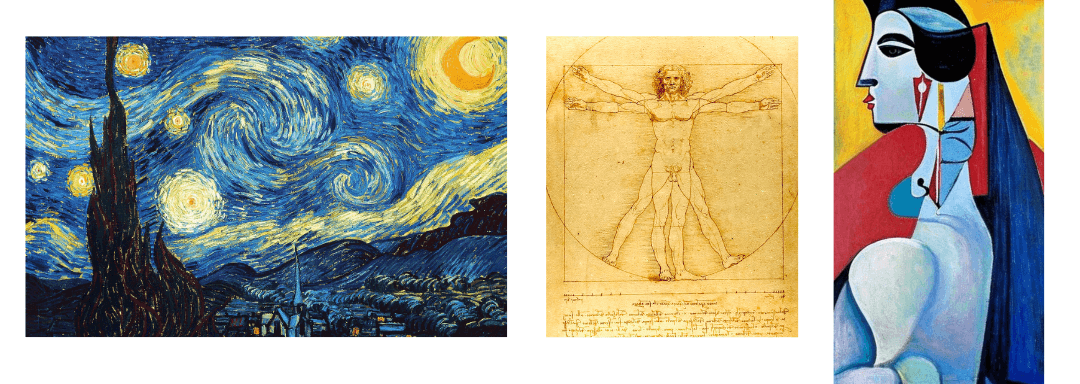
🖌 Want to map out art movements? Use an iconic painting like The Starry Night for inspiration.
🎭 Exploring Renaissance art? Draw a sketch of da Vinci’s Vitruvian Man.
🖼 Looking at modernism? A Picasso cubist portrait could set the tone.
This central image will anchor your entire Mind Map, making it more memorable and engaging.
Step 2: Map the Major Art Movements Like a Family Tree
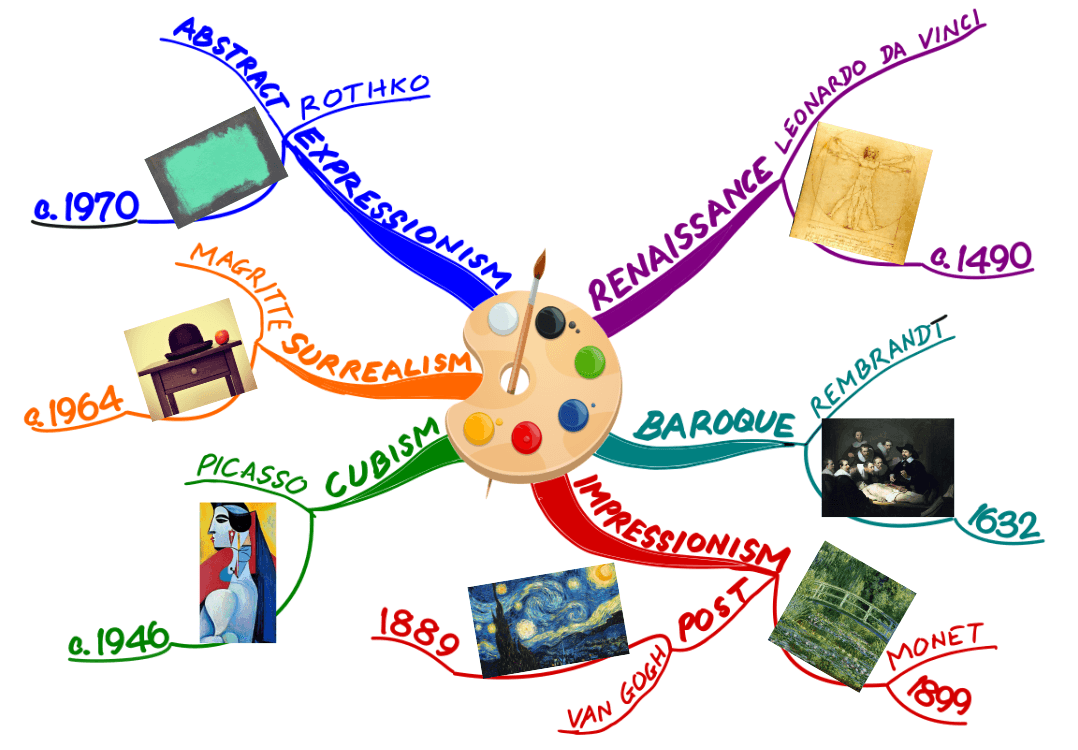
Art history isn’t just a random collection of styles—it’s an evolution of ideas.
A Mind Map lets you see how movements connect and influence each other.
🟢 Start with the big branches (Main movements):
✔ Renaissance – Da Vinci, Michelangelo, Raphael
✔ Baroque – Caravaggio, Rembrandt, Rubens
✔ Impressionism – Monet, Degas, Renoir
✔ Cubism – Picasso, Braque, Gris
✔ Surrealism – Dalí, Magritte, Kahlo
✔ Abstract Expressionism – Pollock, Rothko, de Kooning
🔵 Then add smaller branches for sub-movements and key artists.
For example, under Impressionism, you can add Post-Impressionism and branch off to Van Gogh, Gauguin, and Cézanne.
Now, instead of struggling to remember how Impressionism led to Expressionism, you can see it mapped out clearly.
Step 3: Highlight the Game-Changer Artists
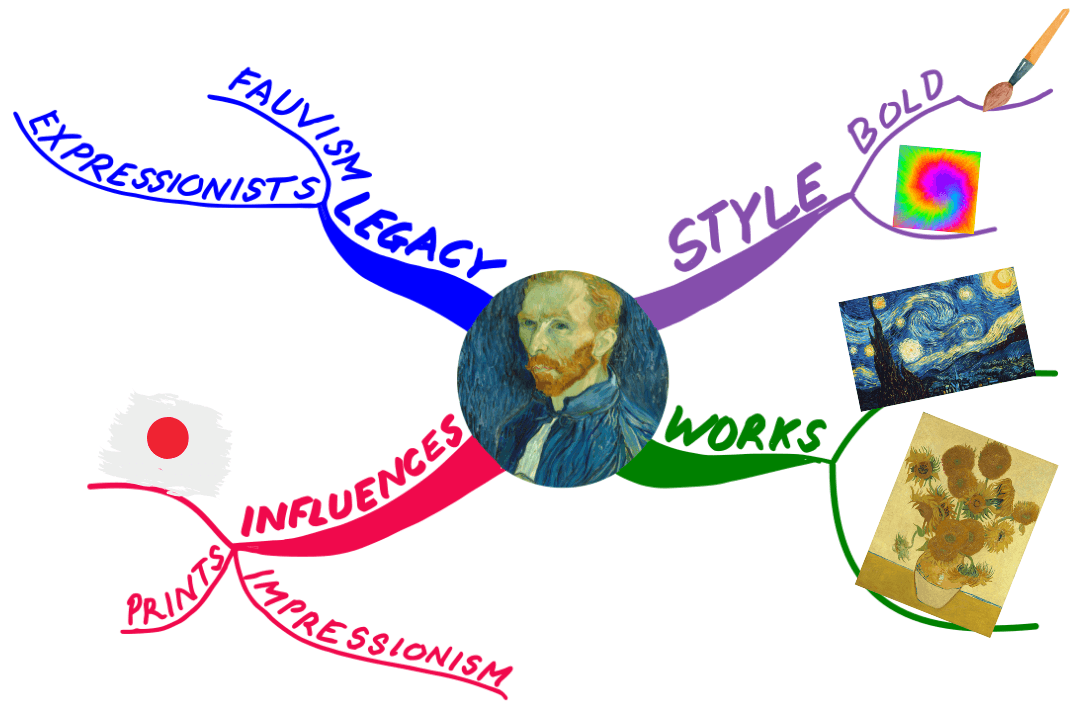
Some artists defined entire movements and changed the course of art history.
Use Mind Mapping to spotlight the rebels, visionaries, and pioneers who shaped artistic styles.
🖍 For each artist, add branches for:
🎨 Their signature style (e.g., Van Gogh = thick brushstrokes, bold colours)
🖼 Famous works (e.g., The Starry Night, Sunflowers)
🌍 Influences (e.g., Japanese prints, Impressionism)
💡 Legacy (e.g., Inspired Expressionists and Fauvism)
Now, instead of memorising facts in isolation, you’re seeing the bigger story unfold—which makes it stick in your mind.
Step 4: Break Down Famous Paintings with Visual Notes
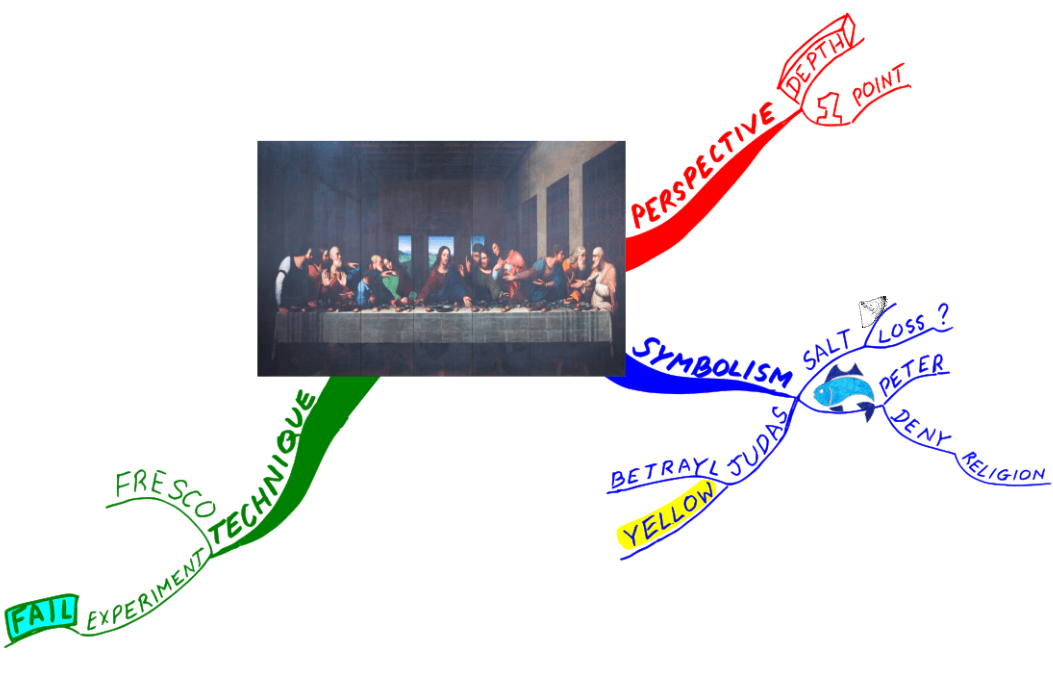
Ever stood in front of a famous painting and wondered: "What am I actually looking at?"
Mind Mapping can help you analyse artwork in a way that makes sense.
Take The Last Supper by Leonardo da Vinci as an example.
🖍 Central Image: Sketch a simplified version of the painting.
🔹 Key branches: Composition, symbolism, perspective, technique.
🔸 Sub-branches:
✔ Perspective – Da Vinci’s use of vanishing point to create depth.
✔ Symbolism – Hidden messages in hand gestures and facial expressions.
✔ Technique – Experimental fresco method that sadly deteriorated over time.
Now, instead of just glancing at a painting, you’re engaging with it deeply, understanding why it’s important and what makes it special.
Step 5: Explore Themes & Meaning Across Time
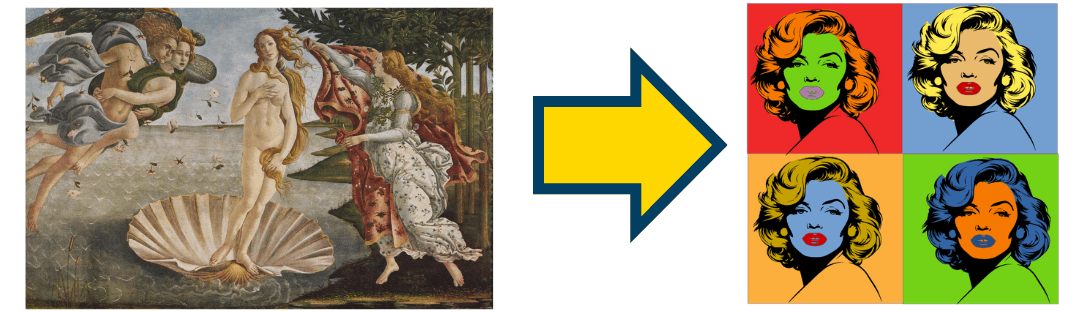
Art is more than just pretty pictures—it’s a reflection of history, culture, and philosophy.
A Mind Map can help you track recurring themes across centuries.
For example:
💀 Death & the Afterlife – Egyptian tomb paintings → Medieval memento mori → vanitas still life paintings.
💖 Love & Romance – Renaissance depictions of Venus → Rococo flirtation scenes → Modern Pop Art interpretations.
💪 Power & Propaganda – Roman emperor statues → Napoleonic portraits → Soviet Socialist Realism.
Seeing these patterns in a Mind Map helps you connect ideas across centuries, making art history even richer.
Why Mind Mapping Works for Art History

✅ Turns a flood of information into a structured visual map
✅ Shows how art movements are connected
✅ Makes complex theories and interpretations easy to digest
✅ Engages both logic and creativity—just like art itself
Your Next Step: Turn Art History into Your Own Masterpiece
Studying art history shouldn’t feel like a dry textbook exercise—it should feel creative, inspiring, and personal.
With Mind Mapping, you can organise, explore, and interact with art history in a way that works for you.
So grab your coloured pens, pick an artist or movement, and start mapping your own art history journey today!
🎨 Want to dive deeper?
🎉 Join The Million Mind Map Newsletter today for your weekly round-up of expert tips and be the first to hear all the latest from Mind Mapping Expert HQ.

Categories

THE PROJECT
(2)

MIND MAPPING
(2)

JOIN IN
(2)

Latest Posts

About me

Hi there 👋 My name is Elaine Colliar, 5 Times World Mind Mapping Champion and your Mentor in Mind Mapping!

Ready to Think Smarter? Join Our Free Mind Mapping Community!
Learn directly from TWO World Champions in Mind Mapping, get exclusive resources, and connect with like-minded thinkers who are transforming their productivity, careers, and creativity.

Get Smarter, One Weekly Idea at a Time
We simplify all our Mind Mapping news for you. Get the week's best insights, tips and news—all curated and delivered in one weekly digest. Organise your thinking, unlock creativity, and achieve more with less effort.
© 2025 The Mind Mapping Expert Ltd